

A griddle gives you room to cook several pancakes at once. The heat needs to suit your appliance and batter so the center can cook before the outside becomes too dark.
This guide covers conventional, leavened pancakes. Follow the recipe or package for the particular batter you are using, especially for very thick pancakes or other specialty styles.
- Choosing a Griddle Temperature for Pancakes
- Managing Heat and Batter on Your Griddle
- 1. Preheat the Griddle in Advance
- 2. Adjust Heat According to the Cooking
- 3. Prepare the Pancake Batter Correctly
- 4. Pour Just the Right Amount of Batter
- 5. Flip at The Right Time
- 6. Check a Fragile Pancake Before Turning It
- 7. Watch for Excessive Browning and an Uncooked Center
- 8. Use the First Pancake to Check Your Setup
Choosing a Griddle Temperature for Pancakes
There is no single setting for every pancake recipe. King Arthur’s Simply Perfect Pancakes uses 375°F on an electric griddle, while Cuisinart’s Blueberry Buttermilk Pancakes uses 350°F in the open-flat griddle position.
These are examples from complete recipes, not universal temperature limits. Use your chosen recipe with suitable equipment rather than automatically preheating to 375°F and dropping to 360°F.
Cooking times vary too. King Arthur’s recipe gives about two minutes before turning and another 1½–2 minutes afterward, while Cuisinart’s gives about 4–5 minutes before turning and approximately three afterward. Keep each timing with its own recipe rather than treating three to four minutes per side as a rule.
Managing Heat and Batter on Your Griddle
Electric and stovetop describe how a griddle is heated; cast iron and nonstick describe its material or surface. An electric griddle can also be nonstick, so these are not separate alternatives.
Use the appliance or cookware instructions alongside your recipe. The controls, preheating method, and suitable utensils can differ.
1. Preheat the Griddle in Advance
Preheat as your appliance and recipe direct. For example, the Presto 22-inch Electric Griddle manual describes a ready light and approximately 5–10 minutes of preheating for that model. Do not assume every griddle needs the same time.
For cast iron, Lodge recommends gradual preheating to medium heat. A burner’s medium setting is not a measured surface temperature, and cast iron’s heat retention does not mean its temperature never changes.
Nonstick surfaces also have different instructions. Follow the product’s guidance rather than assuming that a coating makes every griddle heat faster or permits the same empty-preheating method.
If you want to measure surface heat, use a suitable instrument and follow its instructions. ThermoWorks explains that infrared readings can be misleading on shiny metal and do not measure the inside of food. Water sizzling on a surface is not proof of an exact temperature or a fully cooked pancake.
Recommended Reading: The Inner Workings of A Griddle | Griddle Temperature for French Toast
2. Adjust Heat According to the Cooking
Use the setting in your recipe as a starting point, then watch the result. There is no general requirement to reduce every griddle to 360°F after preheating.
A thermostatically controlled electric griddle cycles its heat to regulate the selected setting. That does not guarantee identical heat everywhere on the surface. A stovetop griddle responds to the burner beneath it.
If the outside browns too quickly while the center is still uncooked, reduce the heat as the appliance allows. If the pancake stays pale and is cooking very slowly, reassess the heat and the recipe instead of automatically turning it down further.
3. Prepare the Pancake Batter Correctly
Follow your recipe’s mixing order and rest period. There is no rule that using one bowl prevents pancakes from rising: Betty Crocker’s scratch pancake recipe, for example, uses one bowl.
For many wheat-flour pancake batters, gentle mixing helps avoid a tough texture. King Arthur’s mixing comparison shows why trying to beat out every small lump can give a poorer result. Use the directions for your formulation rather than applying that explanation to every type of batter.
Rest only as the recipe or package directs. A five-to-fifteen-minute rest is not a requirement for all pancakes, and changing the batter’s proportions without guidance can change how it spreads and cooks.
4. Pour Just the Right Amount of Batter
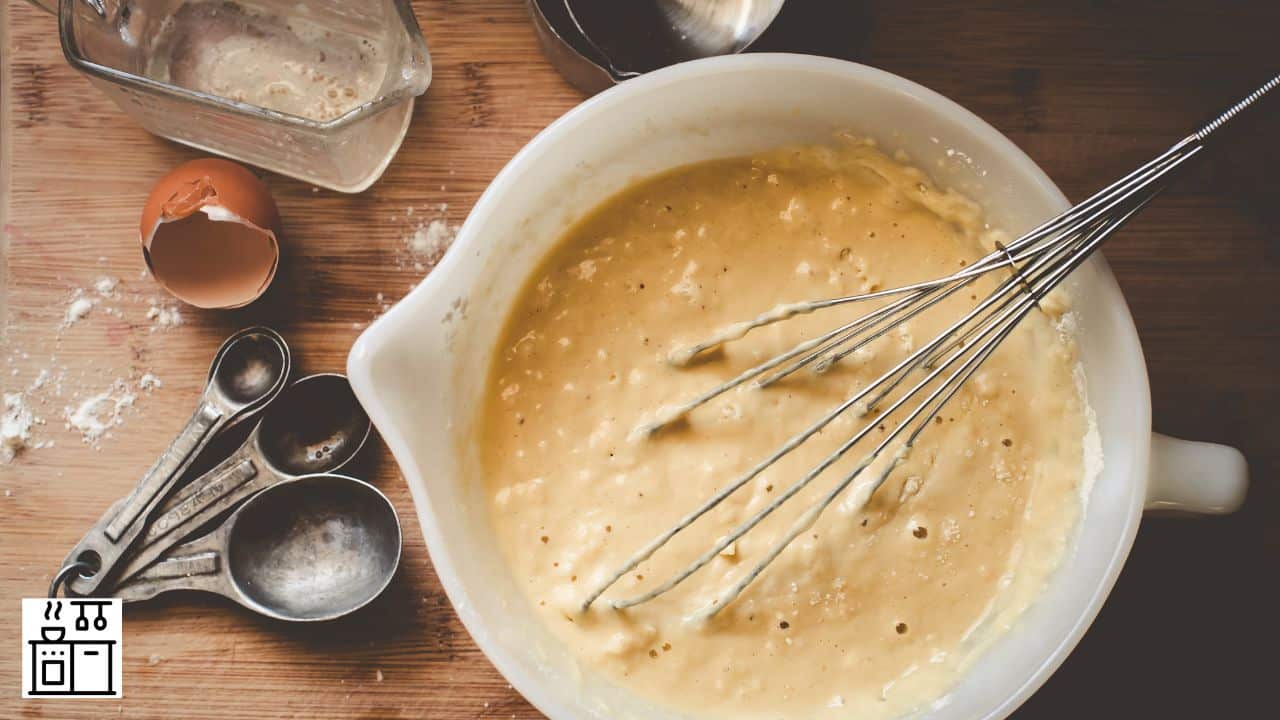
Use a measuring cup, scoop, or suitable ladle to make reasonably consistent portions. That can help you manage the batch, but it does not guarantee that every pancake will spread or cook identically.
A ¼-cup portion is used in the two linked recipes above. Use the amount specified for your own batter and leave room to turn each pancake. The thickness and consistency of the batter still affect its shape and cooking time.
5. Flip at The Right Time
For standard leavened pancakes, look for a combination of cues before turning. King Arthur’s pancake guidance describes broken bubbles on the surface and edges that have turned matte.
Gently lift an edge with a spatula that is suitable for your griddle and check the underside too. Follow your recipe’s browning cues; do not wait for all new bubbles to stop appearing.
These signs help you decide when to turn the pancake. They do not mean that its center is already completely cooked.
6. Check a Fragile Pancake Before Turning It
If a pancake is too fragile to lift, let the first side set further while you watch the underside. Check whether the edges are setting and whether the base is still pale or already browning quickly.
Adjust the heat according to what you see and what your recipe calls for. Automatically lowering it and waiting one extra minute will not fix every problem. Batter consistency can also affect handling, so check the recipe before adding more flour or liquid.
Turn the pancake gently once it can be supported with the spatula, then cook the second side as directed. Do not press it down simply to speed up cooking.
7. Watch for Excessive Browning and an Uncooked Center
If the outside is becoming too dark before the center cooks through, lower the heat as your equipment allows and give the surface time to respond. Do not assume every chewy pancake has a raw center, since the batter and mixing method can affect texture too.
Use your appliance’s controls. A single-control electric griddle, a stovetop plate, and an outdoor multi-burner griddle need different adjustments; a general instruction to close charcoal vents or turn off outer burners does not fit them all.
Check that the center has cooked through according to the recipe or package. The browned outside alone does not establish that the batter inside is ready.
CDC’s raw-dough guidance specifically includes pancake batter: do not taste it raw, and follow the cooking instructions. Raw flour can carry harmful germs even in an egg-free batter. Wash hands, utensils, and surfaces after handling raw ingredients.
Related Reading: Griddle Temperature for Bacon | Griddle Temperature for Grilled Cheese
8. Use the First Pancake to Check Your Setup
Cook a small first pancake before filling the griddle. The University of Illinois Extension cooking guide uses a test pancake to check the batter and cooking conditions.
Use that result to judge whether the heat and portion size suit your recipe. One well-cooked pancake does not guarantee that every area of the griddle has the same heat.
There is no need to treat turning a pancake in the same spot as a mistake. If some areas cook differently, manage the batch accordingly rather than assuming an unused, hotter spot will always give a faster or fluffier result.
