

A griddle gives you room to cook several burgers at once. The heat setting affects browning and cooking speed, but it does not tell you whether the center of each patty is safely cooked.
Choose the setting for your appliance and recipe, then use a food thermometer to check the meat. A flat surface does not guarantee even heat or a fully cooked center.
Choosing a Griddle Temperature for Burgers
There is no universal minimum griddle setting of 350°F for burgers. For example, the Presto 22-inch Electric Slimline Griddle manual lists 325–375°F for its ½-inch hamburgers. That is a model-specific cooking setting, not a food-safety temperature.
Follow your own griddle’s instructions and a recipe that suits the patties you are cooking. A higher surface setting is not automatically better, especially if the outside browns before the center is ready.
Keep surface heat separate from internal temperature. Ground beef, pork, veal, and lamb should reach 160°F inside; ground chicken and turkey should reach 165°F. The thermometer section below explains how to check.
Setting Up Your Griddle for Burgers
Use the steps below with your appliance’s manual. Electric griddles, stovetop plates, and gas griddles do not all have the same controls.
1. Preheat the Griddle
Preheat the griddle as its manual directs. Use its temperature control, ready light, or other instructions rather than assuming that every appliance needs the same number of minutes.
If your griddle has several burners, follow the manufacturer’s directions for the cooking area you want to use. Turning every burner on and then switching off the outer ones is not a general rule for all griddles.
Keep raw patties refrigerated until you are ready to cook them. Preheating helps prepare the cooking surface; it does not mean that the center of the meat instantly reaches a safe temperature.
2. Check the Griddle Temperature Using a Thermometer
If you need to measure surface heat, use a thermometer intended for that job. Blackstone’s temperature guide, for example, describes using an infrared thermometer on its griddle surface.
A surface reading does not replace a food thermometer inserted into the burger. These tools answer different questions: how hot the cooking area is, and how hot the food is inside.
The surface can have hotter and cooler areas, so check the area you are using rather than assuming every part is identical. Water droplets or sizzling sounds are rough observations, not proof of an exact temperature or a safely cooked center.
Recommended: How to Clean a Rusty Blackstone Griddle?
3. Use Oil as Your Griddle Requires
How much oil you need depends on the surface and the food. Lodge’s cast-iron guidance uses a little oil or fat after gradual preheating, while the linked Presto ceramic-nonstick manual allows cooking with little or no oil.
Follow the instructions for your griddle and use suitable heat-resistant utensils. Do not assume that any pastry brush or a paper towel held in your fingers is suitable for applying oil to a hot surface.
4. Place the Burgers on The Griddle
Once the griddle is ready according to its instructions, arrange the patties in one layer. Leave enough room to lift and turn them with a spatula.
If the batch does not fit comfortably, cook fewer patties at a time. Do not use the sound of sizzling as a substitute for following the appliance’s heat instructions or checking the meat later.
5. Maintain the Griddle Temperature
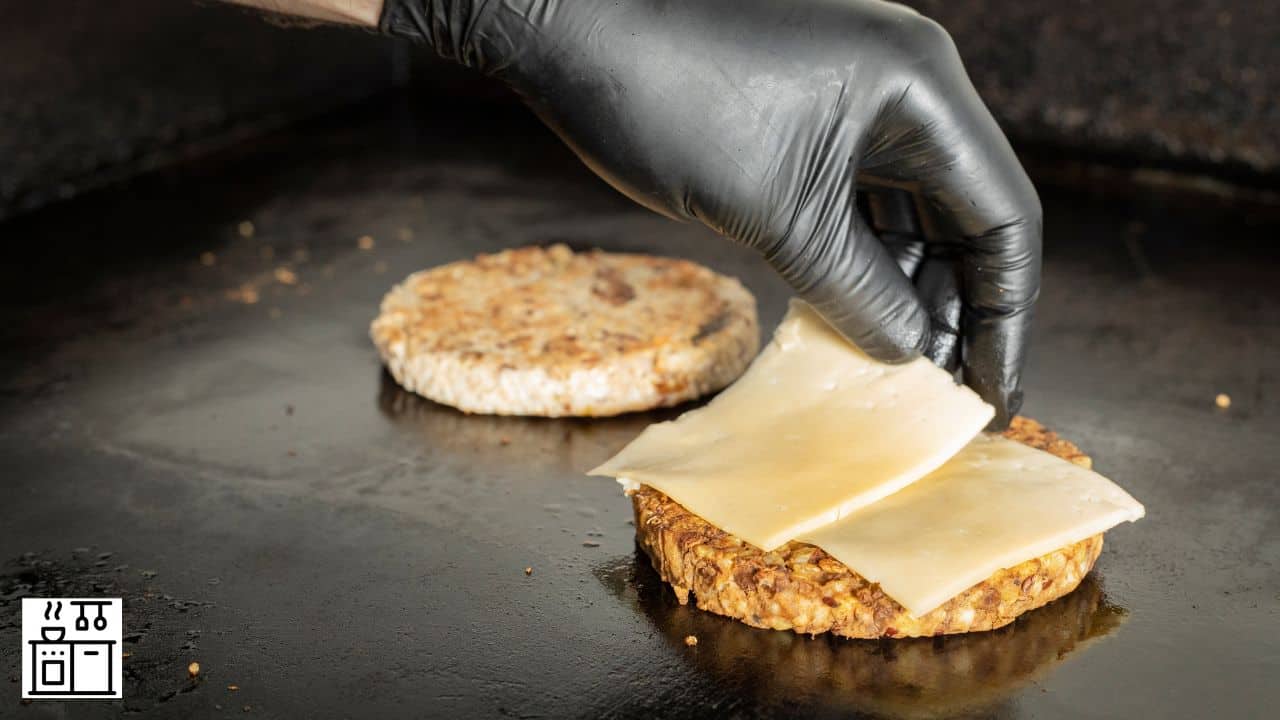
A thermostatically controlled electric griddle cycles its heat to regulate the selected setting. This does not mean that every part of the surface stays at exactly the same temperature.
On a gas griddle, burner controls may let you use different cooking zones. Follow that model’s instructions rather than assuming that turning off an outer burner closes a vent or traps heat in the center.
Watch the food as it cooks and adjust the permitted controls when needed. If the outside is browning too quickly, reduce the heat as appropriate and continue cooking until the center reaches the required internal temperature.
Factors to Consider when Cooking Burgers on A Griddle
Patty thickness, cooking conditions, and the type of meat all matter. Keep these points in mind while you cook.
1. Treat Cooking Times as Estimates
Thicker patties generally take longer than thinner ones, but there is no fixed number of minutes per side that proves a burger is ready. Follow the turning instructions in your recipe and watch for excessive browning.
Use time to plan the meal, then use internal temperature to decide when each burger is done. Do not assume that three, four, or five minutes on each side will suit every patty and griddle.
2. Monitor the Internal Temperature of The Meat
Undercooked ground meat can cause foodborne illness. Before taking the burgers off the heat, check them with a food thermometer rather than relying on time alone.
FDA guidance calls for an internal temperature of at least 160°F for ground beef, pork, veal, and lamb. Ground chicken and turkey should reach 165°F.
Check each patty, since they may finish at different times. For a thin burger, USDA thermometer guidance explains inserting the probe through the side toward the center. Follow your thermometer’s instructions so its sensing area is in the food and is not touching the hot plate.
Meat color and juice color cannot confirm safety. A burger can brown before it reaches the required temperature, or remain pink after reaching it.
If you do not have a food thermometer, cutting the patty open is not an equivalent check. Use a suitable thermometer to verify the internal temperature before serving.
3. Space the Burgers out Evenly
Keep the patties in one layer with room to use your spatula. There is no universal gap of a few inches that makes every burger cook properly.
Spacing helps you handle the food and manage the batch. It does not mean that heat reaches every side equally or that all patties will finish together.
Related: Ideal French Toast Griddle Temperature | Ideal Grilled Cheese Griddle Temperature
4. Consider Shrinking of The Meat
Burgers can shrink as they lose fat and moisture during cooking. The amount varies with the meat and cooking conditions, so do not expect every patty to keep its original size.
For a hand-shaped patty, a small, shallow depression in the center can help it keep a more even shape. Treat this as an optional shaping tip, not a guarantee of final thickness or a way to check doneness.
