

Cucumbers and zucchini look remarkably the same to an untrained eye.
However, these vegetables are entirely different.
Let’s take a closer look at them to understand the differences between them.
- How Are Cucumbers Different from Zucchini?
- 1. They Belong to Different Genera in the Same Family
- 2. They differ in physical appearance.
- 3. Their textures are different.
- 4. There are differences in their cross-section.
- 5. They grow differently in a vegetable patch.
- 6. Their flavor is different.
- 7. They are consumed differently.
- 8. Their nutritional value differs.
- 9. Their origins are different.
- 10. Different parts of them are edible.
How Are Cucumbers Different from Zucchini?
Cucumbers and zucchini are long, cylindrical, green vegetables.
While they look similar, they have different characteristics and uses.
Here are some of the ways in which cucumbers differ from zucchini.
1. They Belong to Different Genera in the Same Family
Cucumber and zucchini both belong to the family Cucurbitaceae, also called the gourd or cucurbit family. They are not in separate plant families.
The common garden cucumber is Cucumis sativus. Zucchini is a summer squash in Cucurbita pepo. Their genus and species distinguish them, even though they are related.
Related reading: Cucumbers That Look Like Watermelons | Is Cucumber a Melon?
Related Reading:
2. They differ in physical appearance.
A zucchini often has a noticeable cut stalk at one end and may have a blossom attached at the other. A harvested cucumber can also retain part of its stalk, so the stem alone is not a universal identification test.
Compare the known variety, shape and skin together. The appearance of either vegetable changes with its harvest stage.
3. Their textures are different.
A fresh cucumber is generally firm and crisp, and its skin can be smooth or bumpy. Young zucchini also has tender skin, but its flesh behaves differently when cooked.
Do not identify a cucumber by softness or assume that all zucchini has a hard, dry rind. Variety, harvest stage and storage condition affect the texture.
4. There are differences in their cross-section.
A sliced garden cucumber often has a clear central seed area, while seeds in young zucchini are less conspicuous within its flesh. Larger, older zucchini can have prominent seeds too.
Flesh color and seed development vary with the variety and maturity. Look at those features together when you cut the vegetable open, rather than treating a green tinge as a universal test.
Related Reading: 8 Simple Tips to Store Cut Cucumber Properly
5. They grow differently in a vegetable patch.
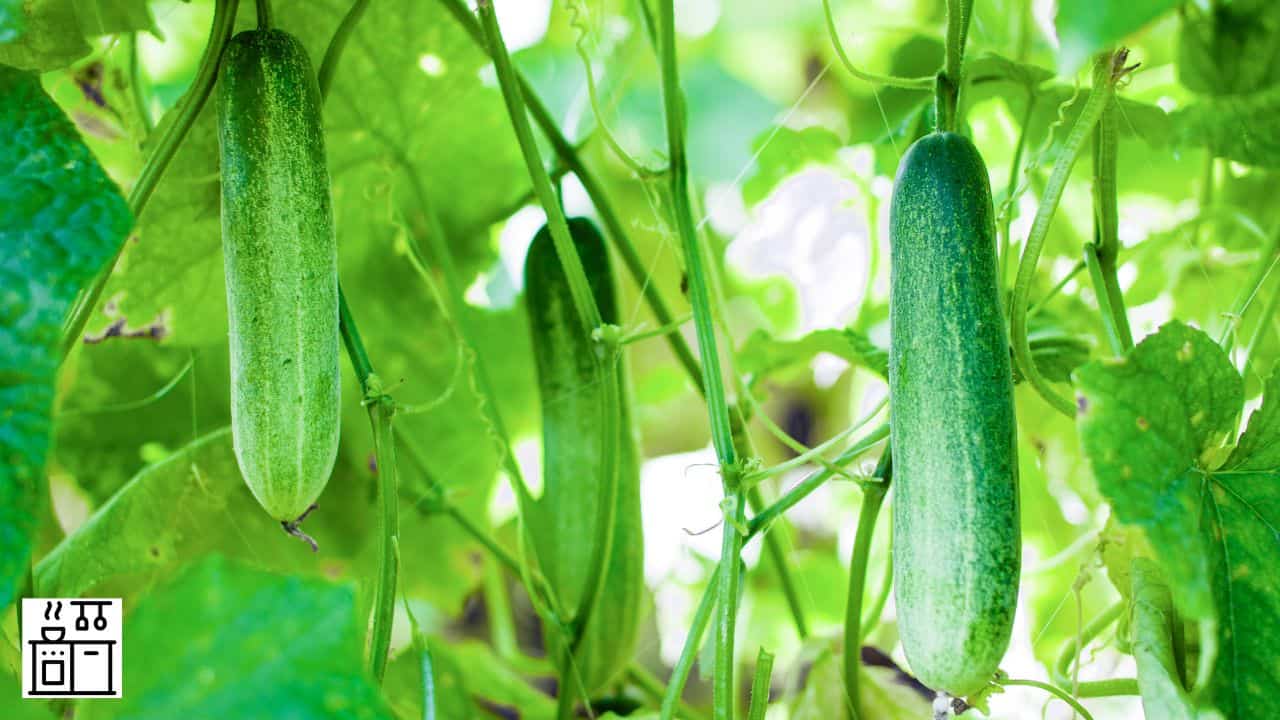
Cucumbers often climb or trail, while many zucchini varieties have a bushy growth habit. Growth varies by cultivar.
However, you can identify if you are looking at a cucumber or zucchini by observing their plants.
The shape of the leaves of both plants is heart-shaped. However, cucumbers vine out and spread all over the space.
The fruits hang from the vines, and they ripen and grow with age.
Cucumbers hang off their vines just like grapes hang off.
However, zucchini grows differently. In this case, the vegetables look like they are growing out of the stems.
Many zucchini varieties have a compact, bushy habit, but some summer squashes form long vines. Check the variety’s growth habit.
The fruits don’t hang down, but they look like they are stuck to the plant.
It’s important to harvest zucchini at the right stage.
If you leave them on the plant for too long, they will become big and seedy.
They lose their flavor when left on the plant for too long.
Related Reading: 15 Cucumbers that Climb While Growing
6. Their flavor is different.
Zucchini and cucumbers taste different whether you eat them raw or cook them.
Both are juicy vegetables with high moisture content. However, cucumbers are cool and crunchy.
They are mostly eaten raw. They have a distinct bite and are refreshingly cool.
Meanwhile, zucchinis are creamier. The flesh is soft and lacks the crunch of cucumbers.
Young zucchini is usually mild. Do not eat a strongly bitter squash or try to make it edible by cooking.
Zucchini is often cooked, but young, tender zucchini can also be used raw in salads.
7. They are consumed differently.
Cucumbers taste best when they are fresh. You can eat them raw when they are still green.
They are usually added to salads, sandwiches, and other dishes where they are used raw.
Cucumbers are also used to make pickles and relish.
Use a tested pickling recipe for cucumbers and follow its ingredient quantities, processing and storage instructions.
Large cucumbers may also be sliced and added to brine solutions for pickling.
These can later be eaten raw or added to salads, wraps, and sandwiches.
You can add cucumber to water for flavor. This does not establish a special detoxifying effect.
Thinly sliced young zucchini can be used raw when you want a mild vegetable in a salad.
Wash zucchini before preparation and choose the method that suits the dish.
However, the creamy flesh of zucchini absorbs flavors well. Hence, this vegetable is widely used for cooking.
Zucchinis are commonly used in casseroles, curries, and other recipes, where they are cooked in sauce or gravy.
Zucchini is also used for baking and making zucchini pasta.
It’s one of the best vegetables that works with a spiralizer.
8. Their nutritional value differs.
Cucumber and zucchini both add water and a range of nutrients to a meal. The amounts depend on the edible portion and preparation, so a peeled cucumber is not directly comparable with an unpeeled cooked serving of zucchini.
For a useful comparison, choose the same serving weight and specify whether each is raw or cooked and whether its skin is included. A small difference in calories is only one part of the overall meal.
9. Their origins are different.
Cucumbers were first reported to be growing in India and China. They grow well in warm and humid climates.
These vegetables are now commercially cultivated all over the world.
Zucchini is supposed to have Italian origins. The name “zucchini” also has an Italian link.
However, these plants reached the United States in the 1900s.
Since then, they have been grown commercially all over the country.
They are also called courgettes in some places.
10. Different parts of them are edible.
The fruit is the part most commonly eaten from both plants. Zucchini blossoms are also used in cooking, often stuffed or fried.
That does not establish that cucumber flowers are poisonous. If you want to use flowers as food, choose correctly identified edible flowers that were grown for that purpose and have not been treated with unsuitable pesticides.
